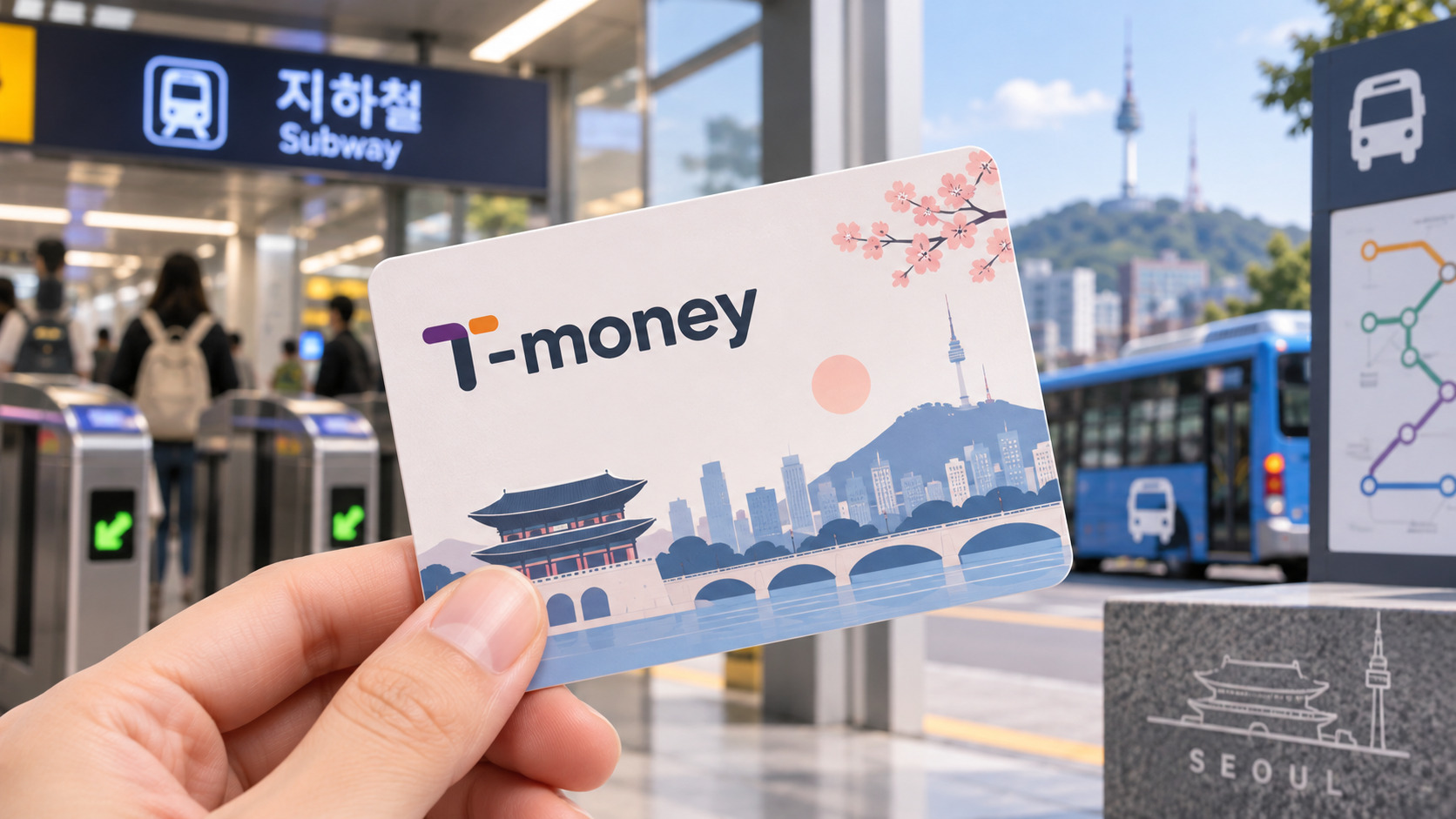
A T-money card is one of the easiest ways to pay for public transportation in Korea. You can use it on subways, buses, and many taxis, making it especially useful for travelers moving around Seoul and other Korean cities.
The confusing part usually comes before the first ride: where to buy a card, how much it costs, how to add money, whether you need cash, and which type of T-money card is best for tourists.
If you are also wondering when to use a foreign credit card, cash, Apple Pay or another payment method during your trip, see our guide to how to pay in Korea as a tourist.
This guide explains the practical details you need to know, including where to buy and top up T-money, how to use it correctly, where it works, how refunds work, and when another transport pass may be a better choice.
- What Is a T-money Card?
- Which T-money Card Should Tourists Buy?
- Where to Buy a T-money Card in Korea
- How to Top Up a T-money Card
- How to Use T-money on Subways and Buses
- Where Can You Use T-money in Korea?
- How to Refund Your Remaining T-money Balance
- T-money vs Climate Card: Which Is Better for Tourists?
- Can Multiple People Share One T-money Card?
- T-money Card FAQ
- Is a T-money Card Worth It for Tourists?
What Is a T-money Card?
T-money is a rechargeable prepaid transportation card widely used across South Korea. Instead of buying a separate ticket for every trip, you load money onto the card and tap it when using public transportation.
Travelers commonly use T-money for:
- Subways
- City buses
- Many taxis
- Airport and express buses that accept T-money
- Payments at some convenience stores and other T-money merchants
For most visitors, the biggest advantage is using one card for everyday transportation without buying a separate ticket for each ride.
T-money is especially useful if you plan to use public transportation regularly or travel outside Seoul, where Seoul-only passes such as the Climate Card may not apply.
Which T-money Card Should Tourists Buy?
You do not need a special tourist card to use public transportation in Korea. A regular T-money card works perfectly well for most visitors, but Tmoney also sells versions designed specifically for international travelers.
The best choice depends on whether you only need transportation or also want extra shopping and payment features.
| Card | Best for | Key difference |
| Regular T-money | Most travelers who mainly need public transportation | Simple prepaid transit card; designs and purchase prices can vary |
| TMONEY TRAVEL CARD | Tourists who want transit plus visitor benefits | Nationwide transit use, T-money merchant payments, and selected tourist discounts |
| TMONEY TRAVEL CARD+ | Travelers who also want broader card payments | Includes Travel Card benefits plus WOWPASS IC payment and balance-management features |
For most short-term travelers, a regular T-money card or the ₩4,000 TMONEY TRAVEL CARD is enough. The ₩6,000 TMONEY TRAVEL CARD+ is more useful if you specifically want the additional WOWPASS payment functions.
One important update: the older KOREA TOUR CARD is no longer sold. Tmoney now directs international visitors to the TMONEY TRAVEL CARD instead.
Where to Buy a T-money Card in Korea
Buying a T-money card is usually easy once you arrive in Korea. Convenience stores are the simplest option for most travelers, and you can find them throughout airports, city centers, and neighborhoods.
Common places to buy a T-money card include:
- Convenience stores such as CU, GS25, 7-ELEVEN, and Emart24
- Seoul subway station information centers on Lines 1–8
A regular T-money card generally costs around ₩3,000–₩5,000, although special character or limited-edition designs may cost more. This is the price of the card itself — you still need to add a separate balance before using it for transportation.
Buying T-money at Incheon Airport
If you want a card immediately after landing, you can buy one before heading into Seoul. Tmoney officially lists the TMONEY TRAVEL CARD at convenience stores and staffed bus ticket offices at Incheon Airport.
For most travelers, there is no need to search for a particular card design at the airport. Buy an available T-money card, add enough balance for your first few trips, and you can start using public transportation right away.
Card availability can vary by store, so if one convenience store is sold out of the design or version you want, check another nearby location.
For airport transportation, terminals, and other arrival essentials, see our Incheon Airport Guide.
How to Top Up a T-money Card
You need to add money to your T-money card before using it for transportation. For a standard prepaid T-money card, purchase and top-up are cash only — foreign-issued credit and debit cards are not accepted.
You can recharge a T-money card at:
- Convenience stores that handle T-money
- Subway station transportation card machines
- Some subway station service centers
At a convenience store, hand the card to the cashier and tell them how much you want to add. At subway stations, look for a transportation card charging machine; many machines offer an English-language menu.
T-money can be recharged from ₩1,000, and you do not need to load a large amount at once. For a short trip, starting with around ₩20,000–₩30,000 and adding more later is usually more practical than keeping a large unused balance on the card.
Can You Top Up T-money With a Foreign Credit Card?
No, not for a standard prepaid T-money card. Korea Tourism Organization’s 2026 transportation guide states that foreign-issued credit cards are not accepted for purchasing or topping up prepaid T-money cards.
This is different from some newer Seoul subway ticket machines, which accept international cards for single-journey tickets and Climate Card short-term passes. That change does not make regular T-money top-ups card-payable.
Keep some Korean won in cash available if you plan to recharge your T-money during your trip.
How to Use T-money on Subways and Buses
Using T-money is simple: tap the card when you enter and again when you leave.
On the subway
Tap your T-money card on the reader at the ticket gate when entering the station. At your destination, tap it again as you pass through the exit gate.
The fare is calculated automatically based on your trip, so you do not need to choose a destination or buy a separate ticket each time.
On buses
Tap your card on the reader when boarding, then tap again before getting off.
The second tap is important. It records where your trip ended and allows the system to calculate transfer discounts correctly. If you forget to tap when leaving the bus, you may lose the transfer discount or be charged an additional fare later.
How T-money Transfer Discounts Work
In Seoul, T-money can automatically apply the integrated transfer discount when you move between eligible buses and subways.
For most daytime trips, your next ride must begin within 30 minutes after tapping out. Between 9 PM and 7 AM, the transfer window is extended to 60 minutes.
You can make up to four eligible transfers, for a maximum of five connected rides. This does not necessarily mean every transfer is completely free — additional fares may apply depending on the distance traveled and the transportation used.
Always use the same T-money card throughout the journey so the system can recognize your transfers.
Where Can You Use T-money in Korea?
T-money is not limited to Seoul. You can use it on most major public transportation systems across South Korea, which makes it useful if your trip includes several cities.
Common uses include:
- Subways and urban rail
- City and local buses
- Many taxis
- Many express and intercity buses
- The AREX All-Stop Train between Incheon Airport and Seoul
- Convenience stores and other merchants displaying the T-money logo
You can also use your T-money balance for small purchases at participating stores, although transportation is still the main reason most travelers need the card.
Where T-money Does Not Replace a Separate Ticket
T-money does not mean you can simply tap onto every train or transportation service in Korea.
For example, the AREX Express Train requires its own ticket, unlike the AREX All-Stop Train. Reserved long-distance trains such as KTX also use separate train tickets rather than a normal T-money tap.
The safest rule is simple: use T-money for ordinary local public transportation, but check ticket requirements for reserved or premium services.
How to Refund Your Remaining T-money Balance
If you still have money left on your T-money card at the end of your trip, you can request a refund instead of leaving a large unused balance.
For most travelers with a small remaining balance, a participating convenience store is a convenient place to ask for a refund, although refund limits can vary by location. If the balance is over ₩50,000, the refund must be handled at Tmoney Town near Seoul Station Exit 10.
Another simple option is to use a small remaining balance at a participating convenience store or other T-money merchant before leaving Korea.
Unless you expect to return soon, it is usually easier to avoid keeping a large balance on the card in the first place and recharge in smaller amounts during your trip.
T-money vs Climate Card: Which Is Better for Tourists?
T-money and the Climate Card solve different problems. T-money is more flexible, while the Climate Card can save money if you plan to use eligible public transportation frequently within Seoul.
| T-money | Climate Card Short-Term Pass | |
| Best for | Most travelers, especially multi-city trips | Travelers using public transportation heavily in Seoul |
| Coverage | Public transportation across many parts of Korea | Eligible Climate Card routes; service area changes October 1, 2026 |
| Payment | Pay for each ride from your stored balance | Unlimited eligible rides during the pass period |
| Tourist pass length | No fixed travel period | 1, 2, 3, 5, or 7 days |
| Airport use | Works on the AREX All-Stop Train and participating airport buses | Coverage is more limited, so check your airport route before relying on it |
Important for trips from October 1, 2026: Climate Card short-term passes will continue, but their service area will change. They will cover travel within Seoul and trips ending at Incheon International Airport, while several surrounding Gyeonggi areas will no longer be included.
Choose T-money if you want the simplest all-purpose option, plan to visit cities outside Seoul, or expect to use public transportation only a few times each day.
A Climate Card short-term pass makes more sense if you will stay mainly in Seoul and expect to take many eligible subway and bus rides within a short period.
You do not have to choose one card for your entire trip. Some travelers use a Climate Card while sightseeing intensively in Seoul and keep a T-money card for airport transportation, trips outside the Climate Card service area, or travel to other cities.
For a complete overview of subways, buses, taxis, fares, and transport apps, see our Seoul Transportation Guide.
Still deciding? Read our full Seoul Climate Card Guide for current prices, coverage, airport rules, and a T-money break-even comparison.
Can Multiple People Share One T-money Card?
If you are traveling as a couple, family, or group, the simplest option is for each person to have their own T-money card.
On Seoul buses, it is possible to pay for multiple passengers with one transportation card if you tell the driver how many people are traveling before tapping. However, multi-passenger transfers have additional rules, and the same system does not work conveniently when transferring to the subway.
Using one card per traveler also makes it much easier to:
- Enter and exit subway gates separately
- Receive the correct transfer discounts
- Track each person’s remaining balance
- Avoid confusion when your group splits up
For most international visitors, sharing one card is not worth the inconvenience just to avoid buying an extra card.
T-money Card FAQ
Can I use T-money outside Seoul?
Yes. T-money works on many public transportation systems across South Korea, including major cities such as Busan. However, special or reserved transportation services may require separate tickets.
If Jeju is part of your trip, our Jeju Transportation Guide explains bus fares, transfers, airport transportation, taxis, rental cars, and car-free travel around the island.
Can I use T-money on KTX?
No. KTX and other reserved intercity trains require separate train tickets. A normal T-money balance cannot be used as your KTX ticket.
If you need a separate train ticket, see our KTX Booking in Korea guide for the official booking options and foreign-card payment details.
Can I use T-money from Incheon Airport to Seoul?
Yes, but it depends on the transportation service. You can use T-money on the AREX All-Stop Train and participating airport buses. The AREX Express Train requires a separate ticket.
Can I top up T-money with a foreign credit card?
Not for a standard prepaid T-money card. According to Korea Tourism Organization’s 2026 transportation guidance, purchase and top-up require cash, so keep some Korean won available.
Can children and teenagers get discounted T-money fares?
Yes. Travelers under 18 can register their date of birth at a convenience store to receive applicable youth fare discounts. Ask for the discount registration when buying or setting up the card.
Is a T-money Card Worth It for Tourists?
For most visitors to Korea, a T-money card is the easiest all-around choice for everyday transportation.
Choose a regular T-money card or TMONEY TRAVEL CARD if you want flexibility across Seoul and other Korean cities. If you will spend most of your trip in Seoul and use public transportation heavily, compare it with the Climate Card before deciding.
Whichever option you choose, keep some Korean won in cash for standard T-money top-ups and tap both when boarding and leaving buses to avoid problems with fares and transfers.
For more first-trip essentials beyond transportation, see our Korea Travel Tips for First-Time Visitors guide for practical advice on navigation, mobile data, translation, emergency numbers, weather, and everyday travel in Korea.