
Getting around Jeju Island takes a little more planning than traveling around Seoul or Busan. The best transportation option depends on where you stay, how many places you want to visit, your budget, and whether you can legally drive in Korea.
For some travelers, a rental car gives the most freedom. For others, buses, taxis, and organized day tours can work perfectly well without driving. You also do not have to rely on just one option for your entire trip.
This Jeju transportation guide compares the practical choices for foreign travelers, including buses, rental cars, taxis, and tours, so you can decide what actually makes sense for your itinerary.
If you are still planning the rest of your trip, our Jeju Island Travel Guide covers how many days to stay, where to base yourself, when to visit, and how to plan each part of the island.
- Quick Answer: What Is the Best Way to Get Around Jeju?
- Getting Around Jeju by Bus
- Renting a Car in Jeju
- Using Taxis in Jeju
- Day Tours and Private Drivers
- Getting From Jeju Airport to Your Base
- Can You Travel Jeju Without a Car?
- Best Jeju Transportation by Traveler Type
- Practical Tips Before You Travel Around Jeju
- Jeju Transportation FAQ
- Final Recommendation
Quick Answer: What Is the Best Way to Get Around Jeju?
For most travelers, the best way to get around Jeju depends on how much freedom you need and whether you can drive legally in Korea.
A rental car is usually the easiest option if you plan to visit several attractions spread around the island. Buses are the most budget-friendly choice, while taxis work well for shorter gaps between bus stops and your destination. If you do not want to drive but want to see several attractions in one day, an organized day tour can save a lot of travel time.
You can also mix transportation methods. Many car-free travelers use buses for longer trips and add taxis or day tours when public transportation becomes inconvenient.
| Option | Best for | Main advantage | Main drawback |
| Rental car | Couples, families, multi-stop itineraries | Most freedom and flexibility | Requires legal driving eligibility |
| Bus | Solo and budget travelers | Lowest-cost option | Longer travel times |
| Taxi | Short trips and last-mile connections | Convenient and flexible | Expensive for frequent long-distance use |
| Day tour | Travelers who do not want to drive | Efficient for several sights in one day | Fixed route and schedule |
Getting Around Jeju by Bus
Jeju’s bus network can take you to most major towns and many tourist areas, making it a practical option if you are traveling without a car. The trade-off is time: destinations that look close on a map may require a transfer or a longer wait between buses.
For a car-free trip, buses work best when you group attractions by area instead of crossing the island several times in one day.
Jeju Bus Fares and T-money
For adults, regular trunk and branch buses cost ₩1,150 with a transportation card. Express buses start at ₩2,000 by card and can cost up to ₩3,000 depending on the distance traveled. Jeju city buses operate on a cashless system, so travelers should use a transportation card or another supported cashless payment method.
T-money and other compatible transportation cards can be used on Jeju buses. Tap your card when boarding and again when getting off. Tapping off is important for transfer discounts and for calculating distance-based fares on express buses.
With a transportation card, you can receive transfer discounts for up to two transfers made within 40 minutes after tapping off. The discount does not apply when transferring back onto the same bus route number.
| Bus type | Adult card fare |
| Regular trunk / branch bus | ₩1,150 |
| Express bus | ₩2,000–₩3,000 |
| Airport Limousine 600 | ₩1,300–₩5,500 |
Official Jeju Bus Information System
Which Jeju Buses Are Most Useful for Tourists?
You do not need to memorize dozens of Jeju bus numbers before your trip. For most visitors, it is more useful to understand three types of buses:
- Express buses: Useful for covering longer distances across the island more quickly than regular local buses.
- Airport limousine buses: Routes in the 600 and 800 series connect Jeju International Airport with major areas toward Jungmun and Seogwipo. The exact route matters, so check your accommodation before boarding.
- Tourist circulation buses: The 810-1/810-2 and 820-1/820-2 routes loop through groups of attractions in different parts of Jeju. They can be convenient when their route matches your itinerary, but they are not an island-wide hop-on, hop-off system.
For ordinary sightseeing days, you will still use regular trunk and branch buses frequently. Rather than choosing a bus only by its number, search your actual destination and compare the route, transfer, and arrival time before leaving.
Bus routes and timetables can change, so check the official Jeju Bus Information System again on the day you travel.
How to Find the Right Bus
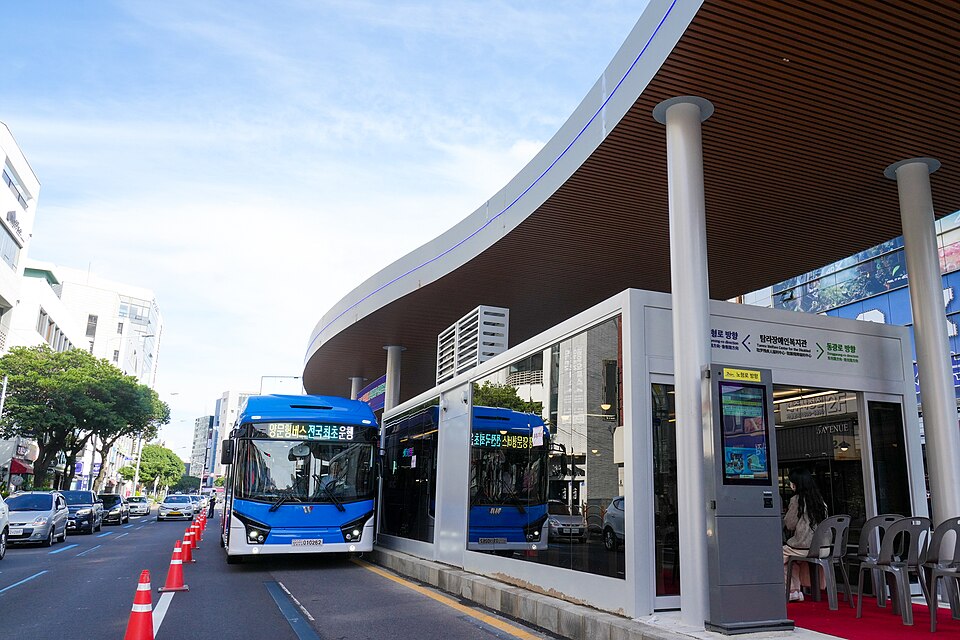
For most foreign travelers, NAVER Map is the easiest place to start when planning a bus trip in Jeju. Search your destination, choose public transportation, and compare the suggested routes based on transfers and estimated travel time. The app supports English and provides real-time public transportation information.
KakaoMap is a useful alternative, especially if you want to compare bus arrival information or a route does not look clear in NAVER Map. It also supports English and provides real-time bus information in Jeju.
Before a longer trip, check the route again shortly before leaving. A route that works well in the morning may be much less convenient later in the day because service frequency varies by route and time.
Practical tip: Save the Korean name or address of your accommodation and important attractions. Searching with the Korean place name can help when an English search does not return the exact location you need.
NAVER Map Download: Android | iPhone
KakaoMap Download: Android | iPhone
Renting a Car in Jeju
A rental car gives you the most flexibility in Jeju, especially if your itinerary includes several attractions outside Jeju City or Seogwipo. It can also reduce the amount of time spent waiting for buses or making transfers.
However, foreign travelers should check their driving eligibility before booking a non-refundable rental car. Having a driver’s license from your home country alone is not necessarily enough to rent and drive a car in Korea.
For IDP rules, insurance, rental costs, and airport pickup details, see our Jeju Car Rental for Foreigners guide.
Can Foreign Tourists Rent a Car in Jeju?
Yes. Short-term foreign visitors can rent a car in Korea if they meet the required driving and identification conditions.
For a standard passenger car, you should generally be prepared with:
- A valid International Driving Permit (IDP) that is accepted in Korea
- Your passport
- Your home-country driver’s license, because some rental companies may ask to see it
- A credit card in the driver’s name
- A minimum age of 21 years
Korea Tourism Organization also states that short-term travelers using an international permit must be within one year of entering Korea. Individual rental companies can apply stricter age, driving-experience, vehicle-class, or payment requirements, so always check the company’s conditions before paying.
| What to check | General requirement |
| International Driving Permit | Required for eligible short-term foreign drivers |
| Passport | Required |
| Home-country driver’s license | Bring it; some companies require it |
| Driver’s credit card | Required for payment under KTO guidance |
| Minimum age | Generally 21+, but company rules may be stricter |
Official Korea Driving & Rental Car Guide
When Is a Rental Car Worth It?
A rental car is most useful when your itinerary includes several attractions spread across different parts of Jeju. It can save a significant amount of time compared with waiting for buses and making transfers, especially outside the main urban areas.
Consider renting a car if:
- You want to visit several attractions in one day.
- You are traveling as a couple, family, or small group and can share the cost.
- Your accommodation is outside central Jeju City or Seogwipo.
- You want flexibility for sunrise spots, coastal roads, cafés, or places with infrequent bus service.
- You have a short trip and want to spend less time waiting for transportation.
A rental car is less necessary if you are staying mainly in Jeju City, traveling slowly on a tight budget, or are not comfortable driving in an unfamiliar country. Travelers without the required driving documents can still build a practical itinerary using buses, taxis, and organized day tours.
If you decide to rent, booking before arriving in Jeju is safer than assuming a suitable car will be available on the day, particularly during busy travel periods.
Using Taxis in Jeju
Taxis are useful in Jeju, but they work best as a supplement to buses rather than your only transportation for long-distance sightseeing.
For a standard mid-size taxi, the base fare is ₩4,300 for the first 2 km. After that, the meter adds ₩100 for every 126 meters, or every 31 seconds when the vehicle is traveling at 15 km/h or slower.
A 20% late-night surcharge applies from 11:00 PM to 4:00 AM. For trips of 20 km or more, a long-distance surcharge also applies. Some dispatched taxis may charge a ₩1,000 call fee.
Taxis are particularly useful for:
- Getting between a bus stop and an attraction that is inconvenient to reach on foot
- Short trips within Jeju City or Seogwipo
- Reaching your accommodation with luggage
- Filling a gap when the next bus would require a long wait
- Early-morning or evening trips when bus service is less convenient
Using taxis for several long cross-island journeys can become expensive. If you expect to make multiple long trips in one day, compare the total cost with a rental car, organized day tour, or private driver instead.
Practical tip: Keep your destination’s Korean name and address on your phone. Showing the exact location in NAVER Map or KakaoMap can be easier than trying to explain the destination verbally.
If you plan to use taxi apps in Jeju, our Korea Taxi Apps for Foreigners guide compares k.ride, Kakao T, Uber and TABA, including foreign-card support, phone number requirements and app differences.
| Taxi fare | Standard mid-size taxi |
| Base fare | ₩4,300 for first 2 km |
| Distance fare | ₩100 per 126 m |
| Low-speed/time fare | ₩100 per 31 sec at 15 km/h or less |
| Late-night surcharge | +20% from 11 PM to 4 AM |
| Call fee | Up to ₩1,000 when applicable |
Official Jeju Taxi Fare Information
Day Tours and Private Drivers
If you do not want to drive, an organized day tour or a private driver can make it much easier to visit several attractions in one day.
A group day tour is usually the better fit if you want a planned itinerary and do not mind following a fixed schedule. Many Jeju tours focus on one part of the island—such as the east or west—so you can see several attractions without working out individual bus connections.
A private driver gives you more flexibility. This can be especially useful for families, small groups, travelers with luggage, or anyone who wants to choose their own stops without renting a car.
Jeju also operates an official Jeju Global Taxi service for foreign visitors. Drivers are available in English, Chinese, or Japanese, and itineraries can be customized. The current official rate for a regular taxi carrying up to four passengers is ₩220,000 for eight hours, while a jumbo taxi for five to seven passengers costs ₩330,000 for eight hours.
The official service notes that an additional ₩30,000 applies when the traveler is staying more than 30 km from downtown Jeju City. Fuel, insurance, parking fees, and the driver’s lunch are included in the listed rate.
Choose a day tour or private driver when the time saved is more valuable to you than the lowest possible transportation cost. If you only plan to visit one or two well-connected places, buses and occasional taxis may still be more economical.
Official Jeju Global Taxi Reservation
Getting From Jeju Airport to Your Base
Where you stay in Jeju makes a big difference to your first trip from the airport. Jeju International Airport is in Jeju City, while popular bases such as Jungmun, central Seogwipo, and Seongsan are much farther away.
For Jeju City, a local bus or taxi is usually the simplest choice. Check your exact accommodation in NAVER Map or KakaoMap rather than choosing a bus only by its route number.
For Jungmun, Bus 600 is one of the most useful direct airport options. It leaves from the limousine bus stop in front of Gate 5 and travels through the Jungmun Tourist Complex before continuing toward Seogwipo.
For Seogwipo, check both the 600 and 800/801 routes. Bus 600 is useful for Jungmun and several stops toward central Seogwipo, while the 800/801 routes travel between the airport and Seogwipo without passing through the Jungmun Tourist Complex.
For Seongsan and the eastern side of Jeju, express buses such as 101 and 111 can be useful depending on your exact destination. Current Visit Jeju guidance confirms airport connections toward Seongsan, but always check the live route before departure because the best bus depends on your accommodation and stop.
If you arrive late, have heavy luggage, or would need several transfers, paying more for a taxi may be worth the time and effort saved.
| Staying in | Good first option to check | What to know |
| Jeju City | Local bus or taxi | Usually the simplest airport transfer |
| Jungmun | Bus 600 | Direct through the Jungmun Tourist Complex |
| Seogwipo | 600 or 800/801 | Choose according to your exact hotel location |
| Seongsan | Express bus 101 or 111 | Confirm the live route and nearest stop |
Official Jeju Airport Public Transportation Guide
Can You Travel Jeju Without a Car?
Yes, you can travel around Jeju without renting a car. The key is to build a slower, geographically focused itinerary rather than trying to cover attractions on opposite sides of the island in the same day.
A car-free trip works especially well if you stay near a major bus corridor, group your sightseeing by area, and are willing to combine buses with occasional taxis or day tours.
It becomes more difficult when your itinerary includes several remote attractions, early-morning destinations, or places with infrequent bus service. In those cases, the time spent waiting and transferring can outweigh the money saved.
| Trip style | Without a car? | Best approach |
| Jeju City-focused trip | Easy | Bus + taxi |
| One region per day | Practical | Bus + occasional taxi |
| Several remote sights in one day | Difficult | Day tour or private driver |
| Fast island-wide itinerary | Not ideal | Rental car if eligible |
If you cannot or do not want to drive, do not treat that as a reason to skip Jeju. Instead, choose accommodation and daily routes around the transportation you can realistically use.
For many travelers, the most practical car-free combination is bus for longer journeys, taxi for short gaps, and a day tour for one attraction-heavy day.
Best Jeju Transportation by Traveler Type
There is no single best way to get around Jeju for everyone. Your group size, budget, driving eligibility, and trip length matter more than choosing the “most popular” option.
| Traveler type | Best starting option | Why |
| Solo traveler | Bus + occasional taxi | Keeps costs low without requiring a car |
| Couple | Rental car or bus + taxi | A car can be worthwhile if you plan several stops |
| Family | Rental car or private driver | Easier for luggage, children, and multi-stop days |
| Budget traveler | Bus | Lowest-cost way to cover most major areas |
| No IDP / do not want to drive | Bus + day tour + taxi | Avoids driving while keeping remote sights accessible |
| Short 2–3 day trip | Rental car or day tour | Saves time when your sightseeing schedule is tight |
For most travelers, the biggest mistake is choosing transportation before deciding where to stay and which part of Jeju to explore each day. Build your itinerary first, then choose the transportation that fits it.
Practical Tips Before You Travel Around Jeju
A little planning can save a lot of time when traveling around Jeju, especially if you are relying on public transportation.
- Group attractions by area. Avoid planning one stop in eastern Jeju, another in the west, and another in Seogwipo on the same day.
- Check the return trip before you leave. Bus frequency can vary, so look at the route back to your accommodation—not just how to get to the attraction.
- Recheck your route shortly before departure. Use NAVER Map, KakaoMap, or the official Jeju Bus Information System for the latest route and arrival information.
- Save Korean place names and addresses. This helps with map searches and makes it easier to show a destination to a taxi driver.
- Keep mobile data available. Live bus information, navigation, translation, and taxi-related searches are much easier when you have a reliable internet connection.
- Leave some buffer in your schedule. Transfers, waiting times, traffic, and weather can make travel around the island take longer than the map initially suggests.
If you are using buses, plan the day around transportation rather than building an aggressive sightseeing schedule first and trying to make the buses fit afterward.
Jeju Transportation FAQ
Do I need a car to travel around Jeju?
No. You can travel around Jeju using buses, taxis, and day tours. A rental car becomes more useful when you want to visit several attractions spread across the island in a limited amount of time.
Can I use T-money on Jeju buses?
Yes. T-money is accepted on Jeju buses. Using a transportation card also gives you a small fare discount on regular buses and allows eligible transfer discounts when you tap off correctly.
Does Jeju have a subway or train system?
No. Jeju Island does not have a subway or passenger train network. Public transportation mainly relies on buses and taxis, which is one reason transportation planning is more important here than in Seoul or Busan.
Can foreign tourists rent a car in Jeju?
Yes, if you meet Korea’s driving requirements. Short-term visitors generally need an accepted International Driving Permit, a passport, and a credit card in the driver’s name. For a standard rental car, the driver generally must be at least 21 years old, and individual rental companies may apply stricter requirements.
Is public transportation good enough for tourists in Jeju?
It can be, especially if you stay near useful bus routes and focus on one part of the island each day. Public transportation becomes less convenient when you try to visit several remote attractions in a short time, so adding an occasional taxi or day tour can make a car-free trip much easier.
Final Recommendation
If you can legally drive in Korea and plan to visit several places across Jeju in a short time, a rental car is usually the most convenient option.
If you prefer not to drive, Jeju is still very manageable with the right plan. Use buses for longer trips, taxis for short gaps, and consider a day tour or private driver when you want to cover several attractions efficiently.
The best transportation choice is the one that matches your itinerary, travel pace, and driving situation—not simply the option that other travelers use most often.