

This Sejong Travel Guide is for travelers who want to explore a different side of Korea beyond the country’s better-known tourist cities. Built around Korea’s major government complex, Sejong is a modern planned city with large green spaces, riverside areas, and landmarks such as Sejong Lake Park, Sejong National Arboretum, and Geumgang Pedestrian Bridge.
For many travelers, Sejong works well as a relaxed day trip or an overnight stop while traveling through central Korea. This guide covers the best things to do, how to get to Sejong and get around, what to eat, where to stay, and how to plan your time efficiently.
Is Sejong Worth Visiting?
Yes — if you want a quieter, modern side of Korea that feels very different from Seoul, Busan, or Gyeongju.
Sejong is especially worth visiting for travelers who enjoy parks, modern architecture, riverside walks, and less crowded destinations. Many of its main attractions are concentrated around the newer part of the city, so you can see several highlights without spending multiple days here.
For a first trip to Korea with very limited time, Sejong would usually come after Seoul, Busan, Jeju, or Gyeongju. But if you are traveling through central Korea or staying near Daejeon, it can be an easy and interesting addition to your itinerary.

Best Things to Do in Sejong
Sejong’s main attractions are relatively close to one another, making it possible to combine several of them in a single day. Start with the city’s best-known outdoor landmark.
1. Walk Around Sejong Lake Park
Sejong Lake Park is one of the easiest places to understand what makes the city different. The large artificial lake is surrounded by walking paths, open lawns, modern architecture, and views of Sejong’s skyline.
It is a good place for a relaxed walk during the day, but late afternoon and early evening are especially pleasant as the city lights begin to reflect on the water. The park also hosts performances, festivals, and other events at different times of the year.
- Admission: Free
- Hours: 5:00 AM–11:00 PM
- Open: Year-round
- Address: 216 Dasom-ro, Sejong-si
- Parking: Available
Official Sejong Lake Park Information
2. Explore Sejong National Arboretum
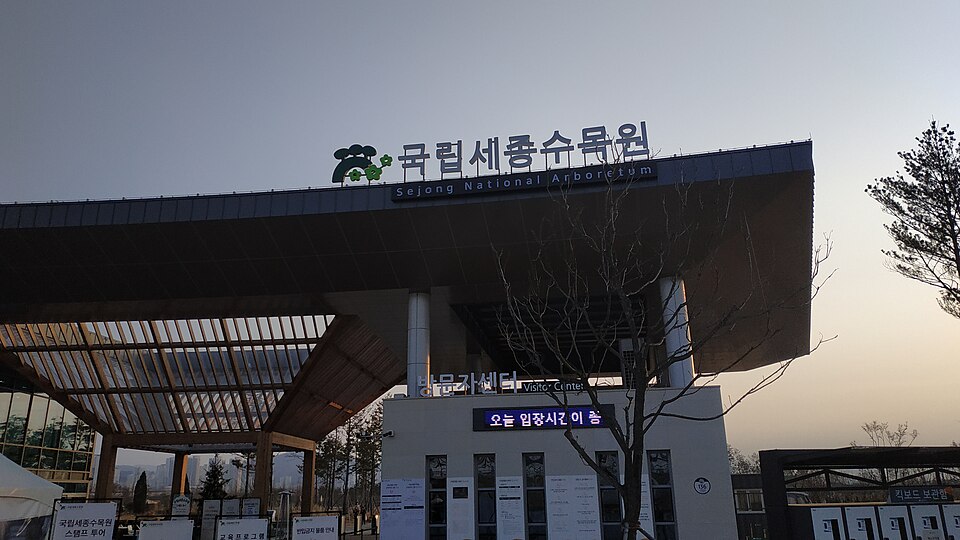
Sejong National Arboretum is one of the city’s standout attractions and a good choice in almost any season. The huge site combines outdoor gardens with the distinctive Four Seasons Exhibition Greenhouse, where you can walk through Mediterranean and tropical plant zones.
Allow at least 2–3 hours if you want to explore both the greenhouse and the main outdoor gardens without rushing.
- Admission: Adults 5,000 won / Teenagers 4,000 won / Children 3,000 won
- March–October: 9:00 AM–6:00 PM
- November–February: 9:00 AM–5:00 PM
- Last admission: 1 hour before closing
- Closed: Mondays, January 1, Seollal, and Chuseok (closed the following day if Monday is a public holiday)
- Address: 136 Sumogwon-ro, Sejong-si
- Parking: Available
Official Sejong National Arboretum Information
3. Walk Across Geumgang Pedestrian Bridge
Geumgang Pedestrian Bridge, also known as Yieungdari, is one of Sejong’s most distinctive landmarks. The circular bridge stretches across the Geumgang River and gives you wide views of the river and the modern city skyline.
Its circular walking route measures 1,446 meters, a reference to 1446, the year Hunminjeongeum was officially promulgated during the reign of King Sejong. The bridge has two levels: the upper level is designed for pedestrians, while the lower level is reserved for bicycles.
For the best atmosphere, visit around sunset and stay until the bridge lights come on.
- Admission: Free
- Hours: 6:00 AM–11:00 PM
- Open: Year-round
- Upper level: Pedestrians
- Lower level: Bicycles
- Parking: Available
Official Geumgang Pedestrian Bridge Information
4. Visit the Government Complex Sejong Rooftop Garden
The Government Complex Sejong Rooftop Garden is one of the city’s most unusual attractions. Stretching for about 3.6 kilometers across 15 government buildings, it is recognized by Guinness World Records as the world’s largest rooftop garden.
Unlike a regular public park, you cannot simply walk in at any time. Visits operate during designated opening periods and follow scheduled group tours.
For the 2026 fall season, tours run from August 31 to November 29, with departures at 10:00 AM, 1:30 PM, and 3:30 PM. The tour is free and usually takes about 60–90 minutes.
- Admission: Free
- 2026 fall opening: August 31–November 29
- Tour times: 10:00 AM / 1:30 PM / 3:30 PM
- Tour duration: About 60–90 minutes
- Reservation: Advance reservation or same-day on-site registration
- Important: Bring a valid ID for identity verification
- Closed: September 24–27, 2026 for Chuseok
- Weather: Tours may be canceled in unsafe weather
Official Government Complex Sejong Rooftop Garden Information
Official Rooftop Garden Tour Schedule
5. Visit the Presidential Archives
The Presidential Archives is one of Sejong’s most distinctive indoor attractions. Its exhibitions use documents, photographs, videos, official gifts, presidential vehicles, and recreated rooms to introduce South Korea’s modern presidential history.
The exhibition hall is spread across several floors, including recreated spaces such as a presidential office and reception room. Because it is located next to Sejong Lake Park, it is easy to combine both places in the same part of your itinerary.
- Admission: Free
- Hours: 10:00 AM–6:00 PM
- Last admission: 5:30 PM
- Closed: Mondays, public holidays, and designated closure days (open on Children’s Day)
- Address: 250 Dasom-ro, Sejong-si
- Parking: Available
- Recommended time: About 1–2 hours
Official Presidential Archives Exhibition Information
How to Get to Sejong
Sejong does not need to be difficult to reach, but the best route depends on where you are coming from. Osong Station is the main high-speed rail gateway for travelers heading to central Sejong, while direct express buses can be more convenient from Seoul.
From Seoul
The simplest option is often a direct express bus from Seoul Express Bus Terminal to Sejong Express & Intercity Bus Terminal. The trip takes roughly 1 hour 30 minutes, although traffic can increase the travel time.
If you prefer the KTX, take a train from Seoul to Osong Station and transfer to a BRT bus toward central Sejong. This option is especially useful during busy road-travel periods.
From Busan or Other Cities by KTX
Take a KTX that stops at Osong Station, then continue into Sejong by BRT. Check your specific train before booking because not every service follows the same stopping pattern.
From Daejeon
Sejong and Daejeon are closely connected by BRT services. Direct services operate from areas including Daejeon Station and Banseok Station, making Sejong practical as a day trip from Daejeon without renting a car.
| From | Recommended route | Best for |
| Seoul | Direct express bus to Sejong | Simplest route |
| Seoul | KTX to Osong + BRT | Avoiding highway traffic |
| Busan / other KTX cities | KTX to Osong + BRT | Long-distance travel |
| Daejeon | BRT to Sejong | Day trips and regional travel |
Book KTX Tickets on the Official KORAIL Website
Check Express Bus Schedules on KOBUS
How to Get Around Sejong
For most visitors, BRT and local buses are the most useful ways to get around Sejong. The city is spread out, so walking between every attraction is not practical, but several major sights are connected by public transportation.
Use BRT and Local Buses
Sejong’s BRT network connects major areas of the city as well as Osong Station and parts of neighboring Daejeon. Local buses fill the gaps between BRT stops and individual attractions.
A T-money card is the easiest payment option for foreign travelers. Tap when boarding and remember to tap again when getting off, especially if you plan to transfer.
Use Taxis for Shorter Gaps
Taxis are useful when a destination is away from a convenient BRT or bus stop, or when you want to save time between attractions. Showing the destination in Korean on NAVER Map can make communication easier.
Use NAVER Map for Routes
NAVER Map is particularly useful in Sejong because it provides public transportation routes, bus-stop information, and real-time arrival information. The app supports English, Korean, Japanese, and Chinese, including English navigation.
Download NAVER Map: iPhone | Android
Official Sejong Bus Information System
Where to Stay in Sejong
Sejong does not have as many accommodation areas as Seoul or Busan, so choosing where to stay is relatively simple. For most first-time visitors, staying near the Government Complex or in Naseong-dong is the most convenient choice.
| Area | Best for | What to expect |
| Eojin-dong / Government Complex | First-time visitors, sightseeing | Easy access to Sejong Lake Park, government buildings, BRT, and major attractions |
| Naseong-dong | Restaurants, evening convenience | A busier commercial area with accommodation, restaurants, cafés, and good BRT access |
| Jochiwon | Rail access, simpler stays | Convenient for Jochiwon Station, with more motel-style and budget-oriented accommodation |
Eojin-dong is the easiest base for sightseeing if this is your first visit. Sejong Lake Park and the Government Complex are nearby, while BRT connections make it relatively easy to reach other parts of the city.
Choose Naseong-dong if you prefer having more restaurants and cafés around your accommodation, especially in the evening. It also works well for travelers arriving by intercity bus or using BRT frequently.
Jochiwon is farther from Sejong’s main modern attractions, so it is not the best base for most first-time tourists. However, it can make sense if you are using Jochiwon Station or find a better-value room there.
What to Eat in Sejong
Sejong is not a city built around one famous signature dish, but it does have a few local foods worth looking for. The best-known local specialty is Jochiwon peach, which has been grown in the area for more than a century.
Try Jochiwon Peaches
Jochiwon is one of Korea’s well-known peach-growing areas. Fresh peaches are at their best in summer, while peach bread, drinks, jam, and other peach products are available at other times of the year.
If you visit during peach season, fresh local peaches make one of the easiest regional foods to try or take home.
Visit Sejong Traditional Market for Local Food
For a more casual local meal, Sejong Traditional Market in Jochiwon is worth considering. Foods associated with the market include green onion fried chicken (padak) and sundae-guk, a hot soup served with Korean-style blood sausage.
This is a better place to look for traditional market food than the newer government district, where dining is centered more around modern restaurants and cafés.
Official Sejong Food Trip Guide
Best Time to Visit Sejong
Spring and autumn are the best seasons to visit Sejong, especially if you plan to spend time around Sejong Lake Park, the arboretum, and the riverside areas.
Spring: April to May
Spring brings mild temperatures and comfortable conditions for walking. It is a good season for outdoor attractions without the summer heat or winter cold.
Summer: June to August
Summer is hot and humid, with Korea’s rainy season typically affecting part of late June and July. Sejong National Arboretum is still a good option because its greenhouse areas provide some relief from the weather.
Autumn: September to November
Autumn is one of the best times to explore Sejong on foot. Temperatures are generally comfortable, and parks and riverside areas become especially pleasant as the season cools.
Sejong also hosts the Sejong Hangeul Festival around Hangeul Day in early October, with performances, exhibitions, hands-on programs, and cultural events celebrating Hangeul and the legacy of King Sejong.
Official Sejong Hangeul Festival Website
Winter: December to February
Winter can be cold, particularly for outdoor attractions such as Sejong Lake Park and Geumgang Pedestrian Bridge. If you visit in winter, combine shorter outdoor stops with indoor attractions such as the Presidential Archives and Sejong National Arboretum.
How Many Days Do You Need in Sejong?
For most first-time visitors, one full day is enough to see Sejong’s main highlights. Stay overnight if you want a slower pace, plan to visit the Government Complex rooftop garden, or want to explore Jochiwon and other areas outside the central government district.
A practical one-day itinerary looks like this:
| Time | Stop | What to do |
| Morning | Sejong National Arboretum | Explore the greenhouse and main gardens |
| Late morning / early afternoon | Presidential Archives | Visit the exhibitions and recreated presidential spaces |
| Afternoon | Sejong Lake Park | Walk around the lake and take a café or lunch break nearby |
| Late afternoon / evening | Geumgang Pedestrian Bridge | Walk across the bridge around sunset and stay for the city lights |
If the Government Complex Sejong Rooftop Garden is open during your visit and you have a reservation, add it to the itinerary by shortening your time at the Presidential Archives or Sejong Lake Park.
Travelers coming from Daejeon can comfortably use this as a day-trip plan. If you are arriving from Seoul, starting early will give you more flexibility, especially if you are traveling by bus.
Practical Tips for Visiting Sejong
A few practical details can make a trip to Sejong much easier:
- Watch out for Monday closures. Sejong National Arboretum and the Presidential Archives are normally closed on Mondays, so avoid planning both attractions for that day.
- Do not underestimate distances. Sejong is spacious and spread out. BRT, local buses, and occasional taxi rides are more practical than trying to walk between every attraction.
- Keep a little Korean won in cash. Credit cards are widely accepted in Korea, but cash can still be useful for transportation-card purchases or top-ups.
- Keep mobile data available. Real-time bus information and NAVER Map are much easier to use with a working internet connection.
- Save the 1330 Korea Travel Helpline. If you need tourism information or language assistance, 1330 provides multilingual travel support, including English.
Official 1330 Korea Travel Helpline
Frequently Asked Questions About Sejong
Is Sejong worth visiting for tourists?
Yes, especially if you enjoy modern architecture, parks, riverside walks, and quieter destinations. Sejong is not usually a first-priority city for a short first trip to Korea, but it works well as a day trip or regional stop.
How many days do you need in Sejong?
One full day is enough for most first-time visitors. Stay overnight if you want a slower schedule, plan to visit Jochiwon, or want to include attractions with fixed tour times.
What is the best station for getting to Sejong by KTX?
Osong Station is the main high-speed rail gateway for central Sejong. From Osong, you can continue into the city by BRT or local bus.
Can you visit Sejong without a car?
Yes. BRT and local buses connect the main areas of the city, and taxis are useful for shorter gaps between attractions. A rental car is not necessary for a typical first-time sightseeing itinerary.
Is Sejong a good day trip from Daejeon?
Yes. Daejeon and Sejong are connected by BRT, making Sejong one of the easier day trips from Daejeon. Starting in the morning gives you enough time to visit the arboretum, lake park, Presidential Archives, and Geumgang Pedestrian Bridge.
Final Thoughts
Sejong is not Korea’s most famous tourist city, but that is part of its appeal. It offers a quieter mix of modern architecture, parks, riverside scenery, cultural attractions, and easy public transportation without the crowds found in larger destinations.
For most travelers, one full day is enough to see the highlights. If you are already visiting Daejeon or traveling through central Korea, Sejong is an easy addition to your itinerary and a good way to experience a very different side of the country.