
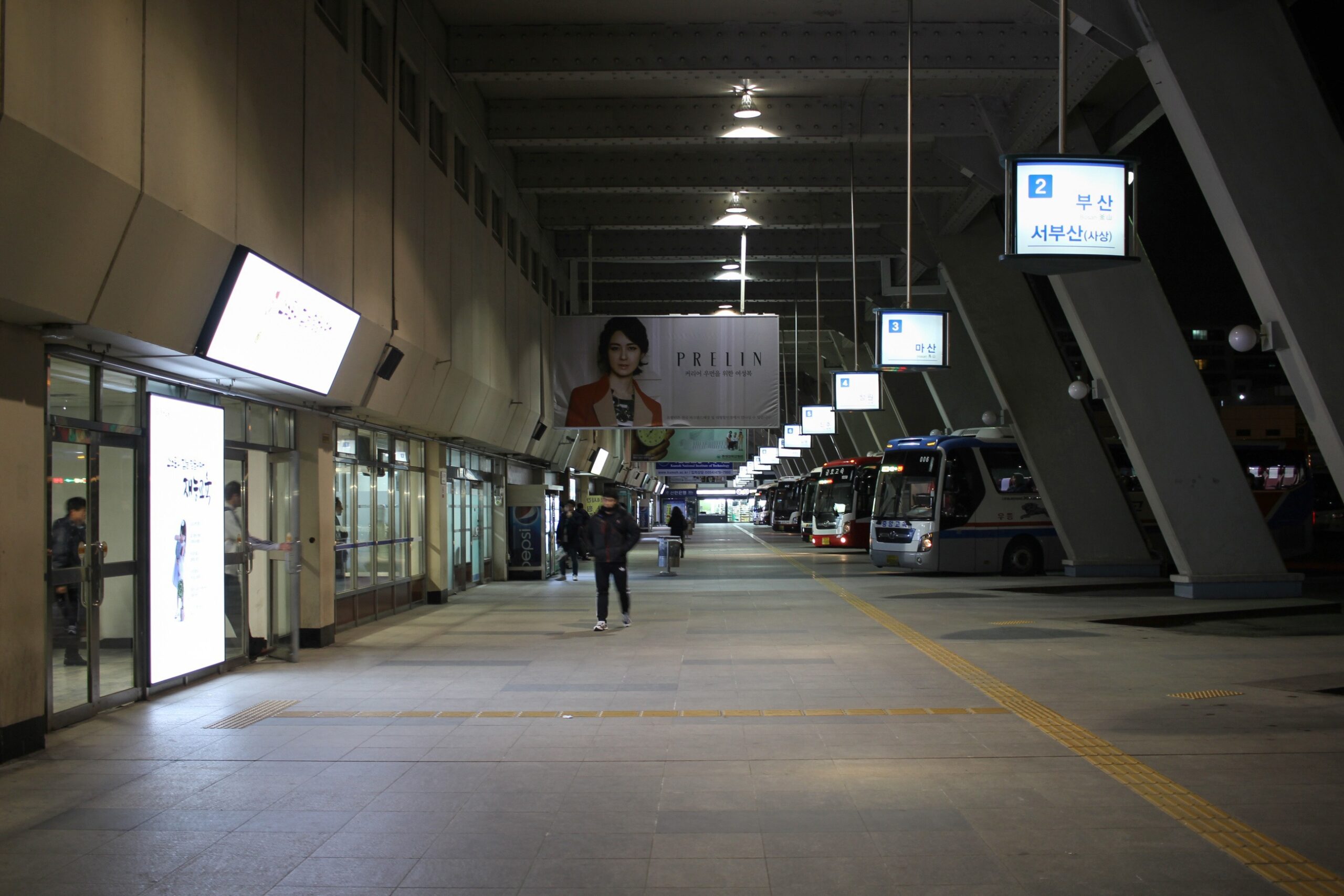
Korea bus booking for foreigners can be confusing, especially when express and intercity buses use different reservation systems.
Korea uses several different reservation systems for express and intercity buses, and the correct website depends on your route and departure terminal. A route that does not appear on KOBUS may still be available through Bustago or TxBus, while some services can only be purchased at the terminal.
The good news is that foreigners can book many Korean bus tickets online, and some reservation systems accept overseas-issued cards. This guide explains which booking service to use, how foreign-card payments work, what to do when your route does not appear online, and how to buy and board a bus if online booking is not available.
- Quick Answer: How Foreigners Can Book Buses in Korea
- Express Bus vs Intercity Bus: What’s the Difference?
- Which Bus Booking Website Should You Use?
- Can You Pay with a Foreign Credit Card?
- How to Book a Bus Ticket Step by Step
- Why Your Bus Route May Not Appear Online
- Buying Bus Tickets at the Terminal
- Ticket Pickup, Mobile Tickets and Boarding
- Bus Classes, Seats and Luggage
- Sold-Out Buses, Weekends and Korean Holidays
- Cancellation and Refunds
- Bus vs KTX: Which Should You Choose?
- Frequently Asked Questions
- Final Tips for Booking Buses in Korea
Quick Answer: How Foreigners Can Book Buses in Korea
For most foreign travelers, the first step is to identify whether your route is an express bus or an intercity bus.
Use KOBUS for many express bus routes. For intercity buses, check TxBus and Bustago. If your route does not appear on one website, do not assume that the bus does not exist—Korea’s long-distance bus network is split across multiple reservation systems.
Klook and GoHanpass also sell selected Korean bus routes and can be easier for international travelers who prefer an English booking interface and familiar payment methods. However, they do not necessarily list every route available in the official Korean systems.
| Booking service | Best for | English available? | What to know |
|---|---|---|---|
| KOBUS | Express buses | Yes | Start here for many major-city express bus routes |
| TxBus | Intercity buses | Yes | Useful for regional and smaller-city routes |
| Bustago | Intercity buses | Yes | Check here if a route is missing from TxBus |
| Klook | Selected express and intercity buses | Yes | International-friendly booking, but route coverage is limited |
| GoHanpass | Selected express and intercity buses | Yes | Another foreigner-friendly option for supported routes |
The most important rule: check more than one booking system before giving up. Express and intercity buses may use different terminals, different websites, and different ticketing systems even when they serve the same city.
Official Korea Express & Intercity Bus Guide
Express Bus vs Intercity Bus: What’s the Difference?
Korea has two main types of long-distance buses: express buses and intercity buses. For travelers, the biggest difference is not the vehicle itself but the route, stops, terminal, and booking system.
Express buses generally connect major cities over long distances and travel mainly on expressways without making intermediate city stops. They are a good option for routes such as Seoul to Busan, Daegu, Daejeon, or other major destinations.
Intercity buses serve a much wider range of destinations. They may stop at other cities or terminals along the way and are especially useful for reaching smaller regional destinations that do not have convenient train service.
One important detail is that express and intercity buses may use different terminals even in the same city. Always check the exact departure terminal shown on your ticket instead of searching only for the city name.
- Choose an express bus when a direct express route serves your destination.
- Check intercity buses for smaller cities, towns, and regional destinations.
- If you cannot find a route on KOBUS, check TxBus or Bustago before assuming there is no bus.
- Always confirm the exact terminal name before traveling to the station.
Which Bus Booking Website Should You Use?
Korea does not use a single booking website for every long-distance bus. The correct service depends on whether your route is classified as an express bus or an intercity bus, and some regional routes appear on only one reservation system.
The easiest approach is to start with the booking service that matches your bus type, then check another system if your route does not appear.
KOBUS: Best for Express Buses
KOBUS is the main booking system for express buses in Korea. It is usually the first place to check for direct express-bus routes between major cities.
The website provides an English interface and lets you search by departure terminal, destination, travel date, bus class, and available seats.
One common mistake is searching only by city name. Korean cities can have several long-distance bus terminals, so check the exact terminal shown in the search results before booking. For example, a bus to the same city may depart from a different terminal depending on the route.
If your destination does not appear on KOBUS, it may be served as an intercity route instead. In that case, check TxBus or Bustago rather than assuming that no bus is available.
Official KOBUS Express Bus Booking
TxBus: Intercity Bus Booking
TxBus is one of Korea’s main reservation systems for intercity buses. It is especially useful for regional routes and destinations that may not appear on KOBUS.
The official TxBus website has a separate English interface where you can search routes, check schedules, make reservations, and view or cancel existing bookings.
Do not assume that every intercity route in Korea will appear on TxBus. Some routes are handled through Bustago instead, so it is worth checking both systems if you cannot find the destination you need.
TxBus also notes that payment options can vary and that some cards may be restricted. For foreign travelers, this means you should not assume that every overseas-issued card will work simply because the route can be reserved online. We will cover foreign-card options and alternatives separately below.
Official TxBus English Booking
Bustago: Another Intercity Bus Booking System
Bustago is another major booking system for intercity buses in Korea. Some regional routes that do not appear on TxBus may be available through Bustago, so it is worth checking both services.
One advantage for international travelers is that Bustago’s official FAQ specifically lists overseas-issued cards among its accepted payment methods. However, the official information does not provide a complete list of supported international card networks or issuers, so individual cards can still encounter payment problems.
Bustago also distinguishes between routes that can be booked online and routes marked for on-site purchase only. If a route appears but cannot be reserved online, you may need to buy the ticket directly at the departure terminal.
The official website has an English booking interface, although some parts of the reservation page may still display Korean text.
Official Bustago English Booking
Klook and GoHanpass: Easier Options for Foreign Travelers
For travelers who have trouble with Korea’s official booking websites, Klook and GoHanpass can be easier alternatives.
Both platforms are designed for international travelers and provide multilingual booking interfaces. They can be particularly useful if you prefer a familiar payment process or encounter problems using an overseas-issued card on a Korean reservation website.
Klook currently offers selected Korean express and intercity bus routes with payment in multiple currencies. For supported bookings, a QR code can be used for boarding without collecting a paper ticket at the terminal.
GoHanpass is another international-friendly option for Korean bus reservations and is especially useful for checking regional intercity routes.
GoHanpass Korea Transport Booking
However, neither platform should be treated as a complete list of every bus in Korea. If your route does not appear, check KOBUS, TxBus, or Bustago before assuming that the service is unavailable.
Can You Pay with a Foreign Credit Card?
Yes, but foreign-card support depends on where you book.
For the least complicated online payment experience, international travelers can use Klook or GoHanpass on routes supported by those platforms. Korea Tourism Organization’s 2026 transportation guidance specifically lists foreign-issued credit cards as accepted for online express and intercity bus bookings through these international services.
Bustago is also worth trying directly. Its official FAQ specifically lists overseas-issued cards among its available payment methods.
KOBUS and TxBus provide online reservation services, but you should not assume that every overseas-issued Visa, Mastercard, or other international card will work with every transaction. Card issuer security checks, payment gateways, browser conditions, and individual routes can still affect whether a payment succeeds.
If online payment fails, you still have another practical option: long-distance bus ticket counters and supported ticket machines at terminals can accept foreign-issued credit cards.
| Booking method | Foreign-issued card | Best use | Important note |
|---|---|---|---|
| KOBUS | Not guaranteed for every online transaction | Express buses | Try another booking method if payment fails |
| TxBus | Not explicitly guaranteed for all foreign cards | Intercity buses | Official English site supports card reservations, but overseas-card compatibility may vary |
| Bustago | Yes, officially listed | Intercity buses | Individual cards can still fail during payment |
| Klook | Yes | Selected express and intercity routes | Easier international payment, but not every route is listed |
| GoHanpass | Yes | Selected express and intercity routes | Useful alternative when official Korean booking systems are difficult |
If one foreign card is declined, do not immediately assume that the bus is sold out or cannot be booked by foreigners. First try another eligible card or booking platform. If the route is still available but online payment does not work, buying the ticket at the departure terminal is usually the simplest fallback.
How to Book a Bus Ticket Step by Step
Booking screens differ slightly between KOBUS, TxBus, and Bustago, but the basic process is similar.
- Choose your departure terminal and destination.
Do not select a terminal only because its name contains the city you are visiting. Large Korean cities can have multiple express and intercity bus terminals. - Select your travel date and number of passengers.
Some booking systems also ask whether you want a one-way or round-trip ticket. - Check the schedule carefully.
Compare the departure time, arrival terminal, bus class, estimated travel time, and remaining seats before continuing. - Select your seat if seat selection is available.
Most reserved long-distance buses let you choose a specific seat during booking, although the exact options depend on the route and operator. - Enter the passenger or reservation information requested by the website.
Bustago allows non-member reservations. Its official instructions state that non-members may be asked for a date of birth and contact number, which can later be used to retrieve the reservation. - Enter your payment details and complete the transaction.
If you are using an overseas-issued card, make sure the payment page actually confirms the transaction before closing the browser. - Check that the reservation was successfully recorded.
Do not rely only on a card authorization or payment notification. Open the reservation lookup page and confirm that your bus, date, time, and seat are listed correctly.
Before leaving for the terminal, check the exact terminal name one more time. Seoul, Busan, Daegu, Daejeon, and other large cities can have several long-distance bus terminals, and going to the wrong one can be difficult to fix close to departure time.
Why Your Bus Route May Not Appear Online
If you cannot find your route online, it does not always mean that the bus has stopped running.
Korea’s long-distance bus network is divided among several reservation systems, and not every route is sold through the same website. A route missing from KOBUS may be an intercity service listed on TxBus or Bustago instead.
There are also routes that appear in the system but are marked for on-site purchase only. Bustago officially notes that these tickets cannot be reserved online and must be purchased at the departure terminal.
Another common issue is the terminal name. A city may have more than one express or intercity terminal, and searching the wrong departure terminal can make an available route appear to be missing.
- Check whether the route is an express bus or an intercity bus.
- Search KOBUS, TxBus, and Bustago rather than relying on only one website.
- Try the exact terminal name instead of searching only by city.
- Look for an “on-site purchase” or similar notice if the route appears but cannot be booked.
- If the schedule still looks incomplete, contact or check the departure terminal before changing your travel plans.
An online “sold out” result also does not always mean that additional tickets will definitely be available at the terminal. Bustago states that some terminals use the same seat inventory for online and counter sales, while others may keep part of their inventory available for on-site ticketing. Do not depend on a walk-up ticket for a busy route unless you have confirmed availability.
Buying Bus Tickets at the Terminal
If online booking is unavailable or your foreign card is declined, you can usually buy a long-distance bus ticket directly at the departure terminal.
Tickets are sold at ticket counters and ticket machines inside bus terminals. Korea Tourism Organization’s 2026 transportation guidance states that foreign-issued credit cards are accepted at express and intercity bus ticket machines and counters.
At the terminal, you will normally need to choose your destination, departure time, and available bus class. After purchasing the ticket, check the departure time, destination terminal, seat number, and boarding platform carefully.
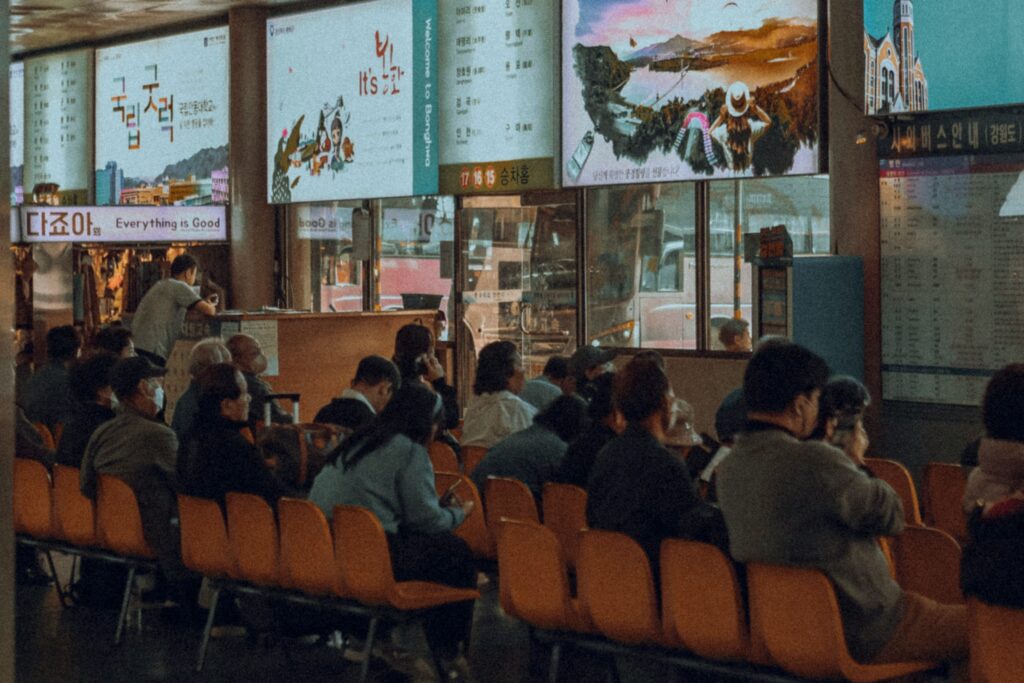
How Early Should You Arrive?
Korea Tourism Organization advises that passengers can typically board a long-distance bus about 5 to 10 minutes before departure.
If you still need to buy or print a ticket, arrive earlier than the boarding time. This is especially important at large terminals, where finding the correct ticket counter and departure platform can take additional time.
After you have your ticket, check the departure information screens in the waiting area for your bus and platform number.
If the route is marked “on-site purchase” in Bustago, online reservation is not available for that service. In that case, purchase the ticket at the departure terminal instead. During busy weekends or holiday periods, do not assume that a walk-up ticket will still be available.
Ticket Pickup, Mobile Tickets and Boarding
Booking a bus online does not always mean that you can board by simply showing the reservation screen on your phone.
Depending on the route and booking method, you may receive a mobile ticket, or you may need to collect a paper ticket at the departure terminal before boarding.
For Bustago reservations, paper tickets can generally be issued at a staffed ticket counter or ticket machine. The booking card may be required for ticket issuance at some terminals, so it is safest to keep the card you used for the reservation with you.
If your route supports a mobile ticket, open the issued ticket before boarding and scan its QR code at the reader when entering the bus. Bustago notes that mobile-ticket availability depends on the route, and some services may operate differently from standard paper-ticket routes.
What Should You Check Before Going to the Terminal?
After booking, check your reservation for three things:
- whether a mobile ticket has actually been issued,
- whether you need to collect a paper ticket at the terminal,
- and whether your booking instructions require you to bring the card used for payment.
Do not treat a payment confirmation or reservation screenshot as a boarding pass unless the booking service specifically identifies it as your usable ticket.
If a paper ticket is required, collect it before the bus departs. Bustago warns that a reserved ticket may no longer be issued after the scheduled departure time.
Bus Classes, Seats and Luggage
Korean long-distance buses can offer several seating classes. The exact names and availability vary by route, but you may see General (일반), Excellent or Udeung (우등), and Premium (프리미엄) when searching for tickets.
General buses use a more conventional seating layout and are usually the cheapest option. Excellent buses have fewer, wider seats with more legroom, while Premium buses offer the most space and privacy. Premium buses are not available on every route or departure.
Seats are normally assigned when you book, so check your seat number before boarding rather than taking any empty seat.
| Bus class | Typical seating | Comfort level | Best for |
|---|---|---|---|
| General | 2+2 | Basic | Shorter trips and lower fares |
| Excellent / Udeung | 2+1 | More legroom and wider seats | Most medium and long trips |
| Premium | 2+1 with fewer seats | Most spacious and private | Long journeys when comfort matters |
Can You Take a Large Suitcase on a Korean Bus?
Yes. Most travelers with a normal checked-size suitcase will use the luggage compartment underneath the bus rather than taking the suitcase into the passenger cabin.
Official Korean government guidance published in 2026 lists the following limits for express and intercity buses:
- Luggage carried inside the passenger cabin: up to 115 cm when the three dimensions are added together, or under 10 kg.
- Luggage placed in the lower luggage compartment: up to 160 cm when the three dimensions are added together, or under 30 kg.
Large suitcases should go in the luggage compartment underneath the bus. Keep your passport, wallet, phone, medication, electronics, and other valuables with you rather than putting them in your checked luggage.
Oversized or excessively heavy items can be refused, especially if they block the aisle, interfere with other passengers, or cannot be stored safely. Vehicle design and individual operators can also affect how much luggage can actually be accepted.
When the bus arrives, confirm that you are loading your suitcase onto the correct bus, especially at a busy terminal with several buses departing at similar times.
Sold-Out Buses, Weekends and Korean Holidays
Long-distance buses can sell out, especially on Friday evenings, Sunday afternoons, long weekends, and major Korean holidays.
The busiest periods are usually Seollal (Lunar New Year) and Chuseok, when millions of people travel between cities. During these holidays, popular express and intercity bus departures can fill much earlier than on a normal weekday.
Holiday booking schedules may also be announced separately from normal reservations, so check when advance sales open instead of assuming that tickets will become available on the usual timetable.
What to Do If Your Bus Is Sold Out
If your preferred departure is sold out, try the following before changing your entire itinerary:
- Check earlier and later departures. A route may have many buses throughout the day even when the most convenient departure is full.
- Check the correct alternative booking system. If you are looking for an intercity route, compare TxBus and Bustago. For express routes, check KOBUS.
- Look at other departure terminals when the city has more than one. A nearby terminal may serve a similar destination, but always compare the arrival point and travel time before booking.
- Check whether a train is a practical alternative. On major city routes, KTX or another train may be faster even if the bus is normally cheaper or more convenient.
- Do not depend on finding a ticket at the terminal. Some terminals may have separate on-site inventory, but others use the same seat inventory as online bookings.
For travel during Seollal, Chuseok, or another major holiday, reserve transportation as soon as the official booking window opens and keep a backup route in mind. Waiting until the day of travel is much riskier than on an ordinary weekday.
Official Korea Public Holiday Calendar
Cancellation and Refunds
Bus cancellation fees in Korea depend on how close you are to departure, the day of travel, and whether you booked an express or intercity bus.
For intercity buses, cancellation is generally free if you cancel at least two days before departure. After that, the fee increases as the departure time gets closer, with higher rates applying on weekends, public holidays, and the Seollal and Chuseok holiday periods.
| When you cancel | Mon–Thu | Fri–Sun / public holidays | Seollal / Chuseok |
|---|---|---|---|
| At least 2 days before departure | 0% | 0% | 0% |
| 1 day before to 3 hours before | 5% | 7.5% | 10% |
| Less than 3 hours before departure | 10% | 15% | 20% |
| After departure | Higher penalties apply | Higher penalties apply | Higher penalties apply |
For intercity buses, the current 2026 rules become much stricter after departure. Cancelling within one hour after departure can incur a 40% fee. From more than one hour to four hours after departure, the current fee is 60%. After four hours, the ticket is generally treated as unused and the full fare can be lost.
Express buses use a different post-departure cutoff. Current government guidance for KOBUS express buses states that cancellations made after departure but before the scheduled arrival time are subject to a 60% fee during the period from May 1, 2026 to April 30, 2027. Once the scheduled arrival time has passed, the fare is no longer refundable.
If you know you will not use a ticket, cancel it as soon as possible rather than simply missing the bus. An unused reservation is not necessarily refunded automatically, and the amount you can recover decreases sharply after departure.
Credit-card refunds may also take several days to appear. Bustago currently advises that a cancelled card payment can take around 3 to 7 days to process, depending on the card issuer.
If you have already printed a Bustago paper ticket, a refund may need to be processed at the departure terminal shown on the ticket.
Official TxBus Cancellation & Refund Policy
Bus vs KTX: Which Should You Choose?
Neither option is always better. KTX is often the easier choice for major cities on Korea’s high-speed rail network, while buses can be much more useful for regional destinations without a convenient train connection.
Choose KTX when saving travel time is important and your destination has a convenient rail station. Choose an express or intercity bus when it provides a direct connection to a smaller city or avoids an extra train-and-bus transfer.
| Factor | Long-distance bus | KTX | Best choice depends on |
|---|---|---|---|
| Destinations | Extensive regional coverage | Major rail-connected cities | Where you are actually going |
| Travel time | Can be affected by road traffic | Generally faster on high-speed routes | Distance and route |
| Transfers | Often direct to smaller cities | May require a local bus or taxi afterward | Station and terminal locations |
| Booking | KOBUS, TxBus, Bustago and selected international platforms | KORAIL website and KORAIL+ | Which system is easier for your route |
| Large luggage | Usually stored underneath the bus | Carried onto the train | Luggage size and convenience |
For destinations such as major cities on the KTX network, compare the total door-to-door travel time, not just the scheduled ride time. A fast train can still require additional local transportation if the railway station is outside the area where you are staying.
For smaller regional destinations, a direct intercity bus can sometimes be simpler even when the journey itself takes longer.
If both options are available, compare the departure point, arrival point, total travel time, current fare, and remaining seats before booking.
If you decide to travel by train, our KTX Booking in Korea guide explains KORAIL+ reservations, foreign-card payment, sold-out trains, and holiday booking.
Frequently Asked Questions
Can foreigners book bus tickets online in Korea?
Yes. Foreign travelers can book many Korean long-distance buses online, but there is no single booking system for every route.
KOBUS is used for express buses, while TxBus and Bustago cover intercity routes. GoHanpass is specifically designed for international visitors and supports both express and intercity bus reservations. Klook also sells selected Korean bus routes.
If one platform does not show your route, check another before assuming that the bus does not exist.
Can I use a foreign credit card to book Korean buses?
Yes, but online foreign-card support varies by booking platform.
Korea Tourism Organization currently identifies Klook and GoHanpass as foreign-card-friendly online options for express buses, and GoHanpass for intercity buses. Bustago’s own FAQ also lists overseas-issued cards as an accepted payment method, although individual card transactions can still fail.
At bus terminals, foreign-issued credit cards are accepted at long-distance bus ticket counters and supported ticket machines.
Do I need a Korean phone number to book a bus?
Not always.
GoHanpass is designed for short-term international visitors and supports sign-up using a passport and an overseas phone number, so a Korean mobile number is not required for that service.
Other Korean booking systems may ask for contact information during a reservation. Bustago, for example, requires a contact number for non-member bookings, but its official FAQ does not clearly state that every foreign phone-number format is accepted.
Avoid entering a fake phone number just to complete a reservation, because the contact information may later be needed to retrieve or verify your booking.
Why can’t I find my bus route online?
The route may be listed on a different booking system, use a different terminal, or be available for on-site purchase only.
Check whether the service is an express or intercity bus, then search KOBUS, TxBus, and Bustago as appropriate. Also confirm the exact departure terminal because large cities can have several long-distance bus terminals.
Can I buy a bus ticket at the terminal on the same day?
Yes, if seats are still available.
You can buy express and intercity bus tickets at terminal counters or ticket machines. However, same-day availability is not guaranteed, especially on weekends, popular routes, and Korean holiday periods.
If your travel date is important, advance booking is safer than depending on a walk-up ticket.
Can I take a large suitcase on an express or intercity bus?
Yes. Large suitcases are normally placed in the luggage compartment underneath the bus.
Current Korean government guidance allows luggage in the lower compartment up to 160 cm when the three dimensions are added together, or under 30 kg. Keep passports, money, electronics, medication, and other valuables with you inside the passenger cabin.
Do I need to print my bus ticket?
It depends on the route and booking method.
Some reservations issue a mobile ticket that can be scanned when boarding, while others require you to collect a paper ticket from the terminal. Check the instructions shown with your reservation before traveling to the terminal.
Do not assume that a payment confirmation or reservation screenshot is automatically a valid boarding ticket.
Final Tips for Booking Buses in Korea
Booking a long-distance bus in Korea becomes much easier once you know which reservation system handles your route.
Start with KOBUS for express buses and TxBus or Bustago for intercity buses. If an overseas-issued card does not work, try a foreigner-friendly booking platform or buy the ticket at the terminal instead.
Before traveling, always double-check the departure terminal, destination terminal, travel date, departure time, seat number, and ticket type. Do not assume that a reservation confirmation alone is enough to board if your booking requires a paper or mobile ticket.
For busy weekends, Seollal, Chuseok, or other major travel periods, book as early as the official reservation window allows.
And if your destination is well connected by high-speed rail, compare the bus with KTX before paying. The best option is the one that gives you the simplest door-to-door journey, not necessarily the shortest scheduled ride time.